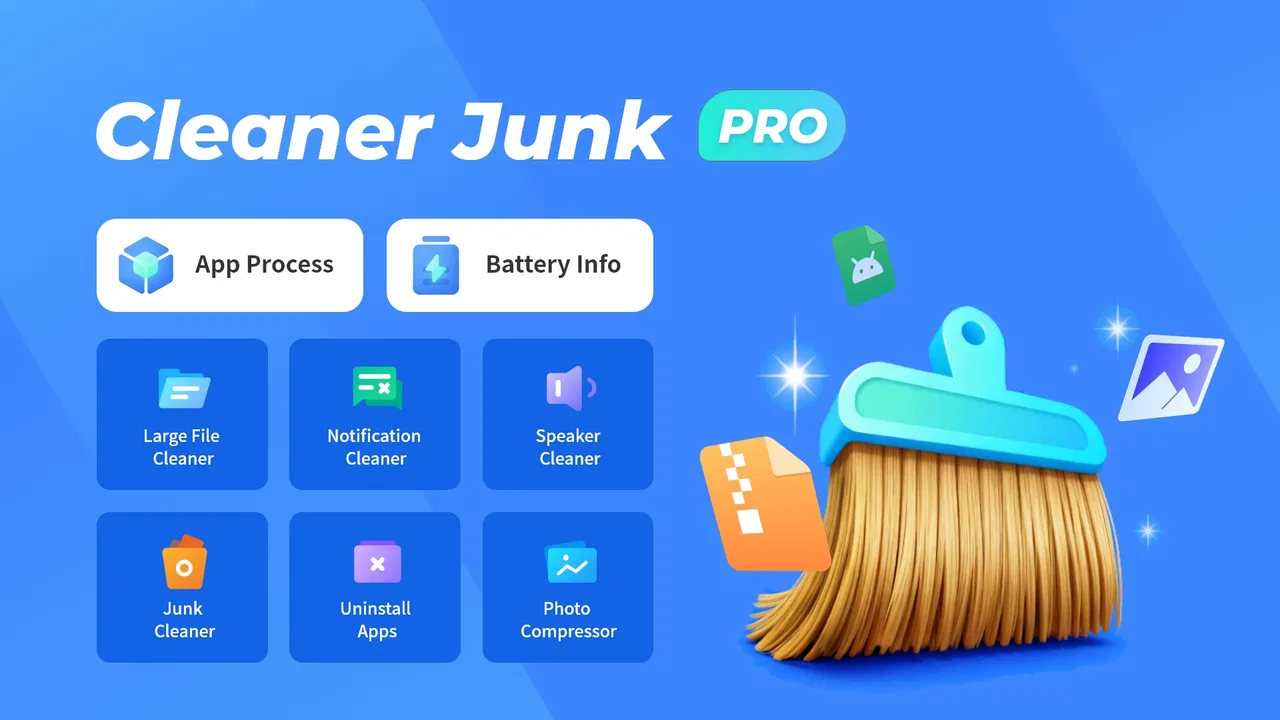
Cleaner Junk Pro
- 4.5
- Rating
- 100.00K
- Installs
- Free
- Price

 Analysis by App-foxy
I installed Cleaner Junk Pro to see whether it could make routine equipment maintenance less annoying, rather than simply adding another icon to my phone. The app comes from ChenTech and sits in the tools category, with a straightforward purpose: helping users deal with unwanted junk on a device. Its store summary presents it as an easy-to-use maintenance tool, while the short description keeps the promise even narrower: “Cleaner Junk.” That simplicity is important because it sets the right expectation. This is not an all-in-one phone manager or a replacement for every system setting. It is a focused utility for people who want a cleaner starting point when their device begins to feel cluttered.
My overall impression is that the app is most useful when I treat cleaning as a small, repeatable task instead of a dramatic rescue operation. The interface is approachable enough for someone who does not enjoy digging through Android menus, and the free price makes trying it low-risk. At the same time, I would not install it expecting miracles or a complete explanation of everything occupying storage. Its value is in reducing friction around a familiar maintenance job.
From a cluttered phone to a cleaner maintenance routine
When I help someone tidy a shared phone, I want the cleanup to be quick without turning into a guess about whose files matter. This section looks at how I’d use the app as a household maintenance tool, with the person who owns the device staying involved in decisions. That practical boundary leads into the setup habits I’d use before anyone starts cleaning.
You May Also Like

 Blood Strike: 2.5 Anniversary
Blood Strike’s Loadouts Turn Every Drop Into a Tactical Gamble
A close look at Blood Strike’s custom loadouts: how fast access to signature weapons reshapes its battle royale rhythm, rewards preparation, and narrows the gap between fights.

 Pandora - Music & Podcasts
Pandora’s Music Is Easy to Start, but Harder to Recover
Pandora’s strength is its low-effort path from a seed to a station. Its weak spot is how much confidence it asks you to place in connection, setup, and quiet recovery.

 8 Ball Pool
 Is Built on Rivalries, Rematches, and Routine
A close look at the rivalries, rematches, shared routines, and unanswered safety questions that turn a quick pool match into a persistent mobile community.

 Samsung Music
’s Quiet Strength Is Playing What You Already Own
Its reach comes less from spectacle than from dependable access to a personal library. That simplicity is both the app’s strongest retention engine and its ceiling.

 AccuWeather: Weather Radar
AccuWeather Review: A Quick, Clear Forecast for Everyday Decisions
For everyday plans, the best forecast is the one you can understand quickly. AccuWeather makes rain timing, radar, and local conditions easy to act on, with a few trade-offs.

 Hill Climb Racing
Why Hill Climb Racing Still Turns Crashes Into One More Run
A tiny car, a bumpy hill and one more upgrade: Hill Climb Racing keeps resurfacing because its simple chaos makes every near-miss feel personal.
More From Our News Desk
View All News


Starting with the real problem
The best way to understand this app is to begin with the situation it is meant to address. Imagine a phone that has accumulated temporary files, leftovers from everyday use, and other digital clutter. The device may still work normally, but storage warnings arrive sooner, browsing feels less tidy, and finding useful files becomes harder. In that moment, many people open the system settings, move through several storage screens, and try to decide what is safe to remove. That process is not especially difficult, but it can be confusing and easy to postpone.
Cleaner Junk Pro gives that maintenance task a more direct home. Instead of making the user start with a long list of technical categories, it frames the experience around cleaning. I found this useful because the first decision becomes simple: I am here to inspect unwanted material and decide what to do with it. That narrow focus is also one of the app’s strengths. It does not try to distract me with unrelated phone-management features or turn a basic cleanup into a complicated dashboard.
There is a sensible distinction between cleaning junk and managing personal content. Photos, downloads, documents, and messages can be valuable even when they contribute to storage pressure. A responsible cleaning workflow should therefore begin with inspection, not blind deletion. My practical advice is to use the app when the problem is accumulated clutter, then handle important personal files separately through the system file manager or the relevant app. The safest cleanup is deliberate, not automatic.
What the first pass feels like
The initial pass is designed for ordinary phone owners rather than technicians. I could approach it without needing to understand every storage label in advance. That matters for family members who regularly ask why their phone is full, or for anyone who wants a maintenance tool that does not make them feel as if they are operating a computer server.
In everyday use, I would open the app before a trip, after a period of heavy browsing, or whenever the phone starts reporting limited space. The useful habit is to make the check part of a routine: inspect first, review the proposed cleanup, and only then continue. Running a cleaner repeatedly without looking at what it identifies is where confidence can turn into carelessness, especially on a device shared with work or family information.
The app’s free status is a practical advantage here. I can test whether its approach suits my phone without committing money to a maintenance subscription. It is also marked for Everyone, which fits the uncomplicated nature of the tool. That does not mean every user should hand over the task without supervision; age suitability and storage safety are different questions. A younger or less technical user may still benefit from an adult showing them how to review a cleanup before confirming it.
The step-by-step flow I would recommend
My preferred workflow starts by closing anything important and making sure I am not in the middle of a download, upload, or document edit. Then I open Cleaner Junk Pro and begin its cleaning process. I treat the first result as an inventory to consider, not as an instruction that must be accepted immediately. This small change in mindset makes the tool more useful because it keeps the user in control of the handoff between detection and deletion.
Next, I review the categories or items presented by the cleaning process. The exact meaning of a junk label matters more than the size of the list. Temporary material is usually easier to approve than anything that resembles a personal file, a saved download, or content that another app may need. If an item is unclear, I leave it alone and investigate through the phone’s own storage tools. A cleaner should save time, not pressure me into guessing.
After that review, I confirm only the cleanup I understand. I would not use the same level of confidence for every result. For example, a routine check after casual browsing is different from a check on a phone used for work projects, offline maps, or media stored for travel. The more important the device, the more conservative my selection becomes. This is one of the non-obvious trade-offs of a focused cleaner: it simplifies discovery, but it does not remove the need for judgement.
Finally, I return to the phone and check whether the original problem has improved. I look for the practical outcome rather than chasing a perfect-looking screen. Can I install the update I was postponing? Is there enough room for a camera session? Did the storage warning disappear? Those questions are more meaningful than simply seeing that a cleaning action completed.
Where the handoffs matter
The most important handoff is between the app and the operating system. Cleaner Junk Pro can make the maintenance route easier to approach, but Android remains the authority over storage, app data, permissions, and the consequences of removal. If the app leads me toward a system confirmation or another screen, I read that step carefully instead of tapping through it automatically. The app is a guide for the task; it is not a substitute for understanding what the phone is about to change.
A second handoff occurs between the cleaner and other apps. Some applications recreate temporary files as soon as they are opened, while others may rely on stored material for offline use. That means a successful cleanup does not necessarily produce a permanent result. If a navigation app, streaming app, browser, or social app quickly builds its working files again, that is normal behavior rather than proof that the cleaner failed. I would judge the tool by whether it helps me regain useful space and clarity at the right moment.
The third handoff is from the phone to the person using it. A family member may ask me to “make it faster,” but cleaning junk is not the same as repairing a weak battery, improving a poor network connection, or fixing an outdated application. I would explain that this tool addresses clutter, not every cause of sluggish performance. That honest expectation prevents disappointment and avoids unnecessary cleaning.
A realistic everyday scenario
Consider a phone used by someone who takes photos during the week, watches short videos, browses shopping pages, and downloads documents for occasional use. Before leaving for a weekend event, the owner discovers that storage is nearly full and wants room for new photos. I would open Cleaner Junk Pro, run the inspection, and review the result with the upcoming use in mind. I would approve clearly disposable junk while leaving personal photos and documents untouched. Then I would check the available space and, if necessary, move valuable media separately rather than treating it as junk.
This scenario shows where the app fits best. It can shorten the first part of the job, which is identifying routine clutter, while the user handles the meaningful files. The handoff is clean: the app helps with the maintenance layer, and the person remains responsible for memories, work, and downloads. If the phone still lacks room afterward, the next step is not to repeat the same cleaning endlessly. I would inspect large personal files, unused applications, and media backups through the appropriate system tools.
What the result means in practice
The result I want from this app is not a dramatic transformation. It is a clearer maintenance path and a device that has enough breathing room for the immediate task. That might mean preparing for a software update, making space before recording video, or simply removing the clutter that has been ignored for too long. The app feels better suited to these practical moments than to users who want a detailed technical report about every byte on their phone.
Its current version is 1.1.0, and the project has already attracted more than a hundred thousand installs. The average rating is 4.5 from around 1.6 thousand ratings, with dozens of written reviews. Those figures suggest that the simple approach resonates with a meaningful group of Android users, although popularity does not replace personal testing. Phones differ, storage habits differ, and a cleaner that feels convenient on one device may feel limited on another.
I also appreciate that the app’s identity remains understandable. ChenTech is not asking me to learn a broad suite of maintenance tools before I can perform a basic cleanup. If I recommend it to a friend, I would describe it as a focused first step for junk removal, not as a complete performance laboratory. That wording helps the friend choose it for the right reason and avoid expecting battery optimization, file recovery, or deep troubleshooting.
Where the flow breaks down
The workflow becomes less convincing when I need detailed control. A user with a complex work phone may want granular explanations for every item, clear separation between temporary data and personal content, or a full storage map before making a decision. A focused cleaner can feel too lightweight in that situation. The usual Android storage screen or a more advanced file-management tool may be better when the real problem is large videos, duplicate documents, offline content, or an oversized application.
There is also a natural limit to what junk cleaning can accomplish. If storage pressure comes from photos, recordings, games, downloaded films, or messaging media, removing temporary clutter may not be enough. I would not keep pressing the clean button in the hope that it will solve a fundamentally different problem. The correct next move is to review large files and personal content, preferably after ensuring that anything important is backed up or otherwise preserved.
Another point of friction is trust. Even an easy interface cannot decide what matters to me. A cached file may be disposable in one context and useful in another, especially when an app supports offline access. That is why I prefer a review-first workflow and why I would be cautious when using the app on someone else’s phone. Convenience is valuable, but it should never be confused with permission to erase without thought.
Users who want a broad device-care suite may also find this app too narrow. If my goal is to inspect battery behavior, manage startup activity, organize photographs, or diagnose network problems, I would choose tools designed for those jobs. Cleaner Junk Pro makes more sense when the starting condition is specifically unwanted clutter and the desired outcome is a simpler cleanup session.
Who should use it and who should skip it
I would recommend Cleaner Junk Pro to Android users who regularly postpone storage maintenance because the built-in route feels buried or technical. It is especially appealing for people who want a free, focused tool, for families helping less confident phone users, and for anyone who needs a quick inspection before an update, trip, or recording session. Its Everyone content rating also makes it approachable for a broad audience, provided users still review what they are removing.
I would skip it if I already understand Android’s storage controls and prefer to manage every folder manually. I would also look elsewhere if my main concern is organizing personal media, recovering deleted files, or diagnosing performance problems unrelated to junk. In those cases, the system tools or a specialized file manager offer a more appropriate handoff and more relevant control.
My recommendation after following the full workflow
After looking at the app from the initial clutter problem through inspection, review, confirmation, and the final storage check, I see Cleaner Junk Pro as a useful convenience layer rather than an essential system component. It makes a routine task easier to start, and that can be enough to turn neglected maintenance into a manageable habit. The free price removes a major barrier, while the focused design keeps the experience understandable.
My recommendation is to use it conservatively: run a scan when you have a clear reason, inspect the proposed cleanup, approve only what you recognize, and measure success against a real need. Do not expect it to replace file management or solve every performance complaint. Used within those boundaries, Cleaner Junk Pro is a sensible choice for straightforward junk cleanup and a friendly entry point for people who want less friction than the standard storage menus provide.
FAQs for Cleaner Junk Pro
01What is Cleaner Junk Pro, and how does it work?
Cleaner Junk Pro is an advanced utility app designed to optimize your device's performance by removing unnecessary files and freeing up storage space. It scans for junk files, app caches, and residual files that are no longer needed. By cleaning these files, it improves the device's speed and efficiency, ensuring smooth operation.
02Is Cleaner Junk Pro safe to use on my device?
Yes, Cleaner Junk Pro is safe to use. It has been designed with user security in mind, ensuring that only unnecessary files are targeted and removed. The app uses advanced algorithms to identify junk without affecting important system files or personal data, providing a secure way to clean and optimize your device.
03How often should I use Cleaner Junk Pro to maintain optimal performance?
For best results, it is recommended to use Cleaner Junk Pro once a week. Regular cleaning helps in maintaining optimal device performance by continuously freeing up storage and preventing the accumulation of junk files. Users can also customize the frequency based on their usage patterns and storage needs.
04Does Cleaner Junk Pro offer any additional features beyond junk cleaning?
Yes, Cleaner Junk Pro offers several additional features. It includes a memory booster to free up RAM, a battery saver to extend battery life, and an app manager to easily uninstall unwanted applications. These tools collectively enhance the overall performance and efficiency of your device.
05Is Cleaner Junk Pro compatible with all Android and iOS devices?
Cleaner Junk Pro is compatible with most Android and iOS devices. However, it is always a good idea to check the app's compatibility with your specific device model and operating system version. This ensures smooth functionality and access to all features offered by the app.
Pros
- User-friendly interface
- Efficient junk removal
- Boosts device performance
- Regular updates
- Supports multiple languages
Cons
- Contains in-app ads
- Requires constant permissions
- Limited features in free version
- Occasional crashes reported
- No real-time customer support

Cleaner Junk Pro
Gallery